Every enterprise generates data. Few enterprises use it well. The gap between data collection and data-driven decision making represents one of the largest untapped opportunities in business today. Enterprise data analytics bridges this gap, transforming raw information into actionable insights that drive revenue, reduce costs, and sharpen competitive advantage. Organizations that master data-driven decision making consistently outperform those that rely on intuition and experience alone.
At Super Express, we combine expertise in AI/ML, SAP HANA, cloud infrastructure, and custom application development to build analytics solutions that deliver real business value. With 150+ completed projects across manufacturing, finance, retail, and healthcare, we help enterprises unlock the full potential of their data.
The Business Case for Enterprise Analytics
Investing in business intelligence solutions is no longer a competitive differentiator — it is a survival requirement. Organizations that fail to leverage their data face decisions made on outdated information, missed market opportunities, and operational inefficiencies that compound over time.
The returns from mature analytics programs include:
- Revenue growth: Identifying cross-sell and upsell opportunities, optimizing pricing strategies, and personalizing customer experiences based on behavioral data.
- Cost reduction: Pinpointing operational waste, optimizing supply chain logistics, and improving resource allocation through data-informed planning.
- Risk management: Detecting fraud, predicting equipment failures, and identifying compliance gaps before they become costly incidents.
- Speed of decision: Real-time dashboards and automated alerts enable leaders to respond to changing conditions in hours rather than weeks.
Data Warehousing: Building the Foundation
Effective analytics requires a solid data foundation. A modern data warehouse consolidates data from disparate sources — ERP systems, CRM platforms, IoT sensors, web analytics, and third-party feeds — into a single, queryable repository.
Modern Data Warehouse Architectures
- Cloud data warehouses: Platforms like Snowflake, Google BigQuery, and Amazon Redshift offer elastic scalability, pay-per-query pricing, and separation of storage from compute that legacy on-premises warehouses cannot match.
- Data lakehouse: A hybrid architecture that combines the flexibility of data lakes (storing raw, unstructured data) with the structure and performance of data warehouses, enabling both exploratory analysis and production reporting from a single platform.
- ETL and ELT pipelines: Automated workflows that extract data from source systems, transform it into analytics-ready formats, and load it into the warehouse on schedules ranging from daily batches to real-time streams.
Real-Time Analytics for Operational Excellence
Batch analytics answers the question “What happened?” Real-time analytics answers “What is happening right now?” — and enables immediate response.
- Stream processing: Technologies like Apache Kafka, Apache Flink, and Amazon Kinesis process data as it arrives, enabling sub-second analytics on operational events.
- Operational dashboards: Live displays in manufacturing plants, logistics centers, and contact centers that show current performance against targets and trigger alerts when thresholds are breached.
- IoT analytics: Processing sensor data from connected equipment to monitor performance, detect anomalies, and trigger automated responses in real time.
Predictive Modeling and Advanced Analytics
Descriptive analytics tells you what happened. Diagnostic analytics explains why. Analytics consulting engagements increasingly focus on predictive and prescriptive analytics — using machine learning to forecast future outcomes and recommend optimal actions.
Common Predictive Use Cases
- Demand forecasting: Machine learning models that predict product demand based on historical patterns, seasonality, economic indicators, and market signals, enabling better inventory management and production planning.
- Customer churn prediction: Identifying customers likely to leave based on engagement patterns, support interactions, and usage trends, enabling proactive retention efforts.
- Predictive maintenance: Forecasting equipment failures before they occur, reducing unplanned downtime and extending asset life.
- Credit risk scoring: Assessing the probability of default for loan applicants using models trained on historical repayment data and external financial signals.
Data Visualization and Self-Service BI
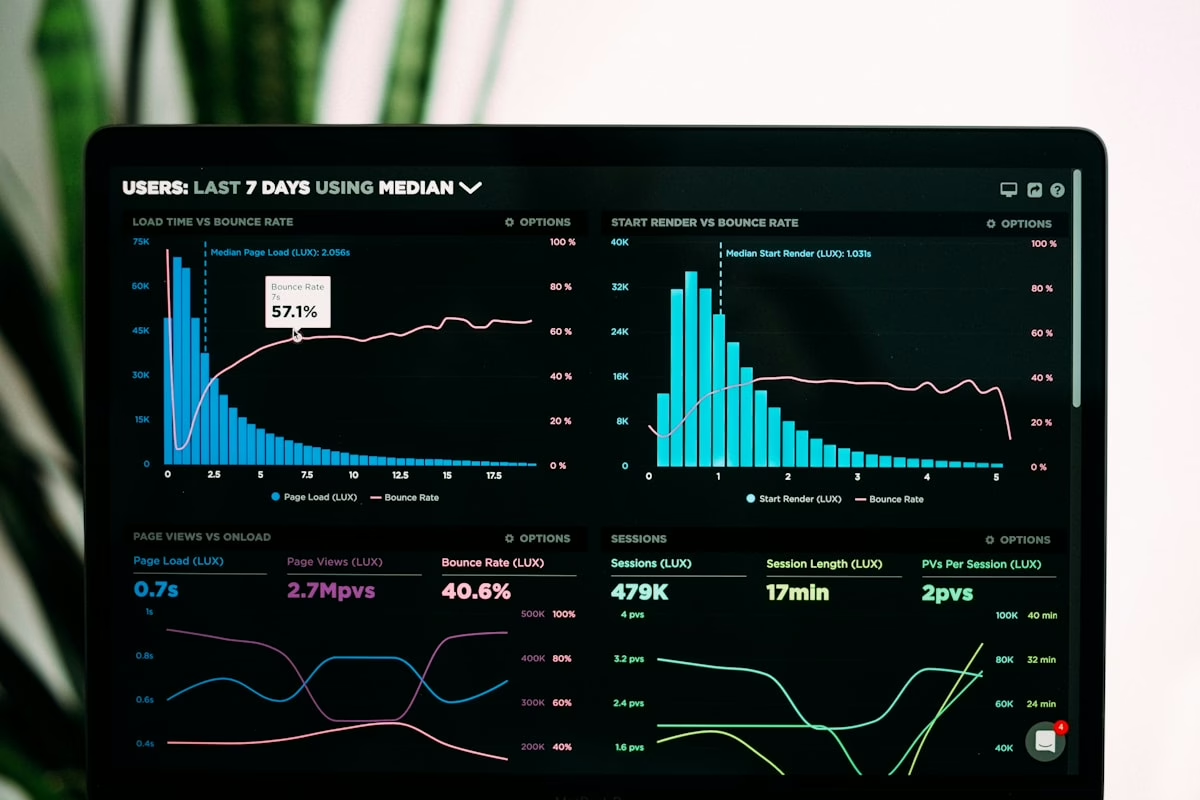
Analytics delivers value only when insights reach decision makers in a form they can understand and act upon. Modern business intelligence solutions emphasize visual, interactive, and self-service experiences.
- Interactive dashboards: Tools like Tableau, Power BI, and Looker enable users to explore data visually, drill into details, and filter views without writing queries.
- Self-service analytics: Empowering business users to create their own reports and analyses reduces dependence on IT teams and accelerates insight generation.
- Embedded analytics: Integrating visualizations and metrics directly into operational applications — ERP screens, CRM dashboards, project management tools — so that data is available in the context where decisions are made.
- Storytelling with data: Going beyond charts and graphs to create narrative presentations that connect data findings to business implications and recommended actions.
Data Governance: Trust and Compliance
Analytics is only as valuable as the data it relies on. Enterprise data analytics programs require robust governance to ensure data quality, security, and compliance.
- Data quality management: Automated validation rules, deduplication processes, and data profiling that identify and remediate quality issues at the source.
- Data catalogs: Searchable inventories of all data assets across the organization, including definitions, ownership, lineage, and quality scores.
- Access control and privacy: Role-based access policies, data masking, and anonymization techniques that protect sensitive information while enabling analysis.
- Regulatory compliance: Ensuring analytics practices comply with GDPR, CCPA, HIPAA, and industry-specific regulations governing data collection, storage, and use.
- Data lineage: Tracking data from source through transformation to consumption, enabling auditability and troubleshooting when results appear unexpected.
Building Your Analytics Capability with Super Express
Transforming an organization into a data-driven enterprise requires more than technology — it demands strategy, architecture, and change management expertise. At Super Express, our analytics consulting engagements begin with understanding your business objectives and data landscape, then designing and implementing solutions that deliver measurable outcomes. Our expertise spans SAP HANA, cloud data platforms, AI/ML, and custom application development, giving us the full-stack capability to build analytics solutions from data pipeline to executive dashboard.
Ready to Turn Your Data Into Competitive Advantage?
Contact Super Express today to discuss how enterprise data analytics and business intelligence solutions can transform your decision making. Visit superrexpress.com/contact or reach out to our team to schedule a consultation.
Featured image via Unsplash

 Byadmin