Address
304 North Cardinal St.
Dorchester Center, MA 02124
Work Hours
Monday to Friday: 7AM - 7PM
Weekend: 10AM - 5PM
Address
304 North Cardinal St.
Dorchester Center, MA 02124
Work Hours
Monday to Friday: 7AM - 7PM
Weekend: 10AM - 5PM

 Byadmin
The concept of creating a virtual replica of a physical asset is no longer science fiction. Digital twin technology has matured into a practical, high-value tool that enterprises across manufacturing, energy, automotive, and infrastructure are deploying to optimize operations, predict failures, and accelerate innovation. By maintaining a real-time digital mirror of physical systems, organizations gain unprecedented visibility into performance, enabling decisions grounded in data rather than intuition.
At Super Express, we leverage our expertise in IoT, AI/ML, and cloud infrastructure to help enterprises implement digital twin solutions that deliver measurable operational improvements. With over a decade of experience serving industries like manufacturing, oil and gas, power, and automotive, we understand the technical and business requirements of successful digital twin deployments.
A digital twin is a dynamic virtual representation of a physical object, process, or system. Unlike a static 3D model or simulation, a digital twin continuously ingests real-time data from sensors embedded in the physical asset, updating its virtual state to reflect current conditions. This living connection between physical and digital enables continuous monitoring, simulation, and optimization.
The power of industrial digital twins lies in their ability to answer three critical questions: What is happening now? What will happen next? What should we do about it?
Sensors stream operational data to the digital twin, providing a live view of asset performance. Operators can monitor equipment health, production throughput, energy consumption, and quality metrics from a centralized dashboard — even for assets distributed across multiple facilities or geographies.
Machine learning models trained on historical and real-time data identify patterns that precede equipment failures, quality defects, or process deviations. Rather than reacting to breakdowns, maintenance teams can intervene proactively, scheduling repairs during planned downtime and avoiding costly unplanned outages.
Digital twins enable what-if analysis without risking physical assets. Engineers can simulate the impact of changing operating parameters, introducing new materials, or modifying production schedules — testing hundreds of scenarios in the time it would take to run a single physical trial.
Manufacturing leads digital twin adoption, driven by the immediate ROI from reduced downtime, improved quality, and optimized throughput.
Predictive maintenance is often the first and highest-value application of digital twin technology. Traditional maintenance strategies — run-to-failure or calendar-based preventive maintenance — are either too reactive or too wasteful. Digital twins enable condition-based maintenance that optimizes the useful life of every component.
Digital twins extend beyond individual assets to model entire supply chains. A supply chain digital twin ingests data from suppliers, logistics providers, warehouses, and production facilities to create a holistic view of material flow.
Digital twins do not exist in isolation. Their value multiplies when integrated with broader IoT infrastructure and AI capabilities.
Successful digital twin implementation requires expertise that spans IoT engineering, data science, cloud architecture, and domain-specific knowledge. At Super Express, we bring all of these capabilities together through our integrated methodology. With 150+ completed projects across 15+ countries and deep expertise in manufacturing, energy, and automotive, we help enterprises move from concept to production-grade digital twin deployments.
Contact Super Express today to discuss how digital twin solutions can optimize your operations, reduce costs, and accelerate innovation. Visit superrexpress.com/contact or reach out to our team to schedule a consultation.
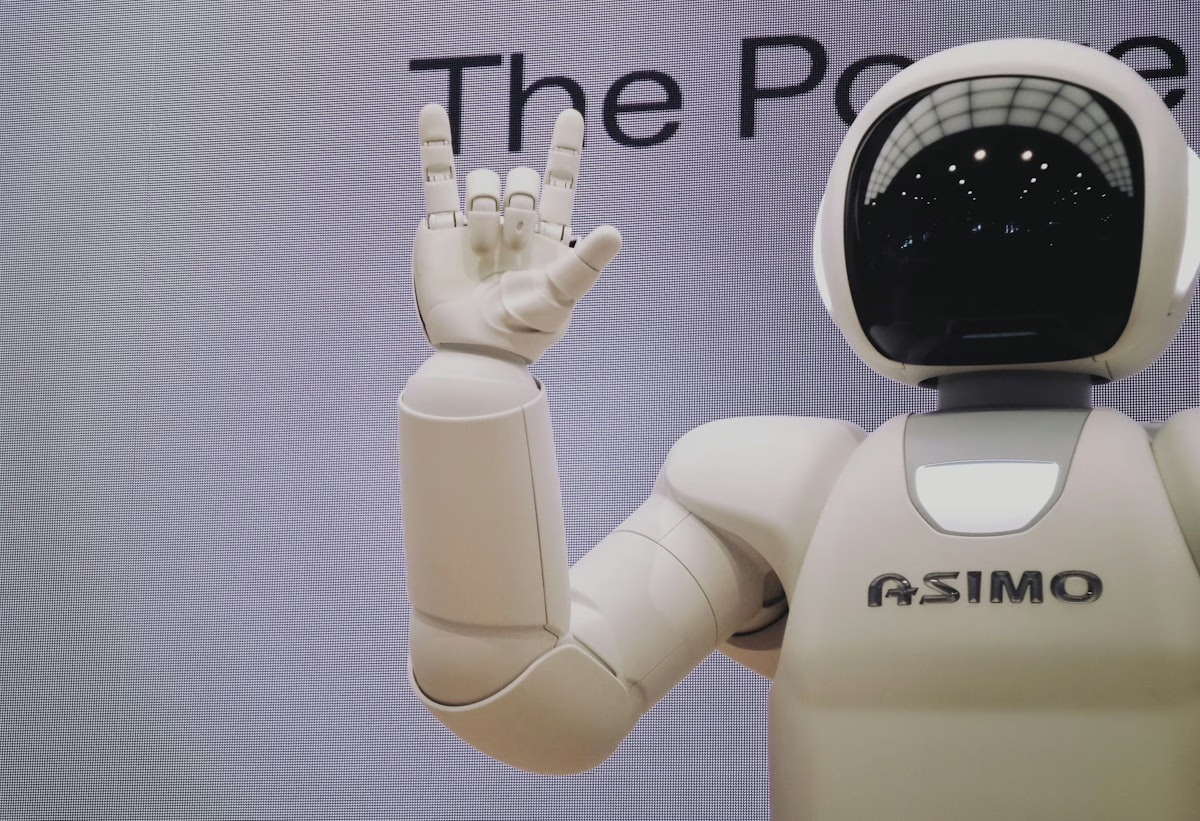
Featured image via Unsplash